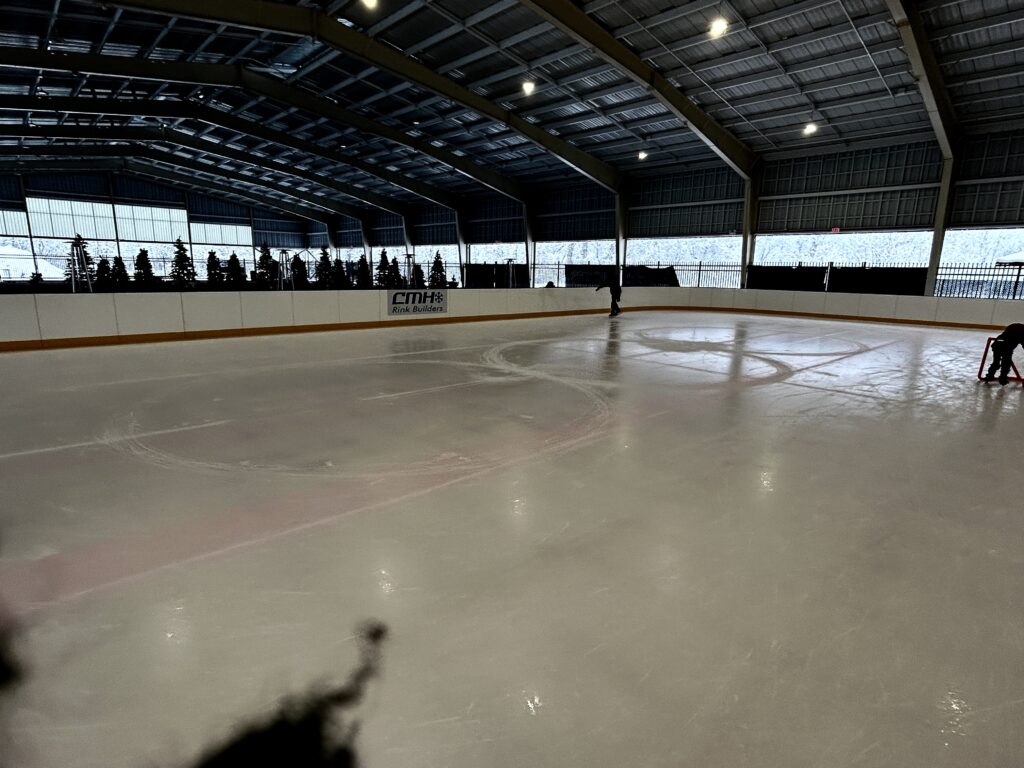
This week I stopped by a small local outdoor ice rink in upstate New York, open to the public for FREE. I arrived right when it opened at 10am and told the rink attendants I wanted to “cut some figures.” When I got on the ice I proceeded to measure out space for three large circles, which left just enough space left over for people to plain-skate around the outside. “Lucky there aren’t two of us making figure artwork today,” I thought, since there was only enough space for one. Over the next 90+ minutes I proceeded to methodically go through my technique like I do every day: forward, backward, serpentines, three-turns; and eventually on to small figures. The rink attended said they were wondering when I was going to do some tricks. I told him that loops ARE the tricks. I showed him some photos from the WFS Championship and he said “that could be art.” “Yes it IS art,” I said. Then I went on to practice more loops. Everyone else was plain-skating around the rink, all had a good time, and I’m pretty sure nobody else had seen anything like it. Sometime after I left, they erased all my work with a tractor-pulled mini resurfacing machine.
Those two hours were intensely satisfying: starting with a blank canvas, I carved some beautiful circles and loops into it: results I could see, results that exist beyond the moment they are created. Most importantly, the figure artwork I created was not a practice or rehearsal it was the real thing. I walked into the rink and over the next 90 minutes, I cut some figures. It did not need anyone other than me, the creator, to justify the act of creation. Then I captured the results with my camera and wrote a blog post about it.
Dance, on the other hand, exists only in the present and cannot be fully observed or appreciated by its creator. We feel something is missing if we dance just for ourselves: dance demands performance, a ritual in which we gather dancers and observers in a room together so the dance can be properly observed, thereby justifying the act of dance. We attach value to dance in part based on the venue it is performed in and how many people see it, and we go to enormous lengths to ensure our dance is experienced by an audience. In a similar vein, competition justifies the sport of figure skating.
Figure artwork is in many ways like dance: it involves physics, bodies moving through space and an incredible journey of self-discovery as we train our bodies to create it. But figure artwork also stands in contrast to dance: the artwork is best observed by the creator, and the act of creation is itself a form of performance art.
That is what is so special about figure art work. Every day that we step on a clean sheet of ice and cut some figures, it is both a practice and a performance as we experience the journey of self discovery, the body puzzle that is each feature. And when we finish the experience, we can enjoy the results, until the Zamboni comes again. Or maybe we snap a photo. Others might see and appreciate. But in the end no audience beyond the creator is required to justify the creation.