Original thread: https://www.facebook.com/groups/adultsskatetoo/permalink/2027143018189019/
OP: It tickles me to death to fall. It means I’m pushing my boundaries, and that makes me happy. Here practicing my snap into air position.
Eliz: I disagree there is no reason to fall on backspin.
OP: Well, I wasn’t working on backspin. I was working on snapping as fast as I could into an “air position” and lost my balance. I’m not sure there is a good way to both play it perfectly safe and technically controlled, and work on expanding your current skill set. Would love your insight and a video if you have one!
Stephanie… The “air position” of the six large jumps IS the backspin. The safest way (AFAIK) to learn an Axel jump (and all double+ jumps thereafter) is: (1) get really comfortable with a good solid backspin; (2) learn a waltz jump landing in a backspin; (3) go on to a full Axel jump. (I’m still on step 1, inching my way into step 2). In your video… both back spin and the six jumps end on an RBO edge without stepping ont the L foot, just pull out into landing position. So I’m not sure what role stepping onto the LF edge was meant to play, and that is where things went awry.
The safest way to build technical control and expand your current skill set is to practice figures. Figures are very technical, very controlled, very challenging… and very safe. Once skills are mastered on the figure 8, you can bring them into the center for free skating. For example… to learn a backspin (decent enough to support an Axel jump), I first needed to learn how to pin my weight over the ball of my foot on BO edges and keep it there. It took me 18 months of placing my weight in the wrong place on BO8 figure before my body figured that out; and during that time, backspin for me was downright dangerous. Which leads to a principle of safe skill development: a complex movement like a jump or a spin can be broken down into its component parts and techniques. Each component needs to be built and mastered (well enough) before they can be safely assembled. That is especially true for any jump: whatever is wrong, either you can fix it gliding on an edge, or fix it flying through the air just before you crash land. Your choice.
I spent my first 18 months (skating daily), 90% on figures. The tiny bit of free skating I did do was unnecessarily dangerous. I broke a rib on a bunny hop. I nearly crashed landed a waltz jump. One time I fell by catching my heels just standing around. I even managed to fall backwards once doing a grand battement on the ice. More recently I’ve fallen on a toe loop jump and loop jump, in both cases because I was over-skating my technical ability at the time (too fast and too much power, rather than working up slowly). None of these falls were necessary, and none of them taught me better technique. In all of them, the lesson was… play stupid games, win stupid prizes.
After 18 months of quality edge work on figures, my body felt safe enough and I spontaneously began free skating. That did not eliminate the falls, but the technical foundation did help. Unfortunately, every fall causes injuries and pain. My most recent serious fall I wasn’t even jumping, I just lost my edge on back crossovers and wiped out. That made a bruise bigger than my hand on my hip, and lasted a month.
Nothing is perfectly safe, but there ARE safer vs more dangerous ways to learn the skills. Trying complex moves without mastering their simpler components, and adding more power and speed when you are not yet ready, are both ways to be more dangerous.
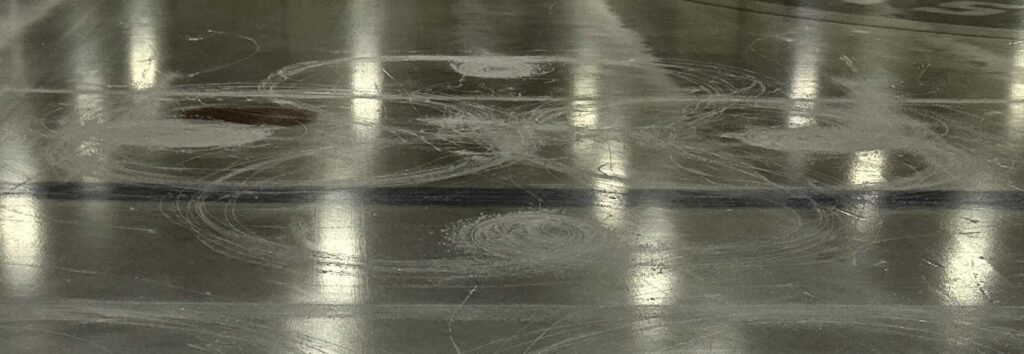
Sorry no videos, I don’t really have anyone to take videos of me. I do take a lot of photos of my figures, enjoy this Loop de Loop figure (FO loop and FO inside loop, both feet). You can also see here for a waltz jump photo I made, along with an explanation of what went into it:
Enjoy!